Lake Trout EpiGenomics Project
From Single-Reference Associations to Two-Genome Evidence — Salvelinus namaycush Ecotypes
Two Ecotypes, Two Genomes
Lake trout (Salvelinus namaycush) in the Great Lakes occur as divergent ecotypes that share water but not lifestyle:
- Lean: shallow-water dwelling, elongate body, low lipid content
- Siscowet: deep-water specialist, robust body, high lipid storage
The project asks: which genes carry the epigenetic and structural differences between the ecotypes, and what phenotypes might they shape? The first pass answered this against a single public reference genome. That reference was built from a lean-background fish, so every siscowet-specific signal was inflated by divergence and nothing could be checked from the other side. We have now assembled each ecotype’s own genome from PacBio HiFi reads, annotated both, aligned them to each other, and re-derived the key comparisons bidirectionally. This page reports what survived that test, what did not, and what remains open.
lean 2.58 Gb · siscowet 2.84 Gb
on native coordinates
66 flag-free · 3 lose coding sequence
retained any two-genome support
Read this as hypothesis-generating, now with a stronger floor. The two-genome layer replaces single-reference association with bidirectional read evidence for a small set of genes, and it shows which earlier signals are not supported once the ecotype genomes are examined directly. No functional validation has been performed, sample size is four fish per ecotype, and the assemblies are contig-level.
What Changed: Single Reference → Two Genomes
| Layer | Single-reference analysis (2025) | Two-genome analysis (2026) |
|---|---|---|
| Genome | NCBI SaNama_1.0, a Seneca-strain lean doubled haploid | Lean and siscowet hifiasm assemblies, haplotig-purged, 12,700 and 8,159 contigs |
| Annotation | 46,359 RefSeq genes | Liftoff transfer: 55,437 lean, 59,968 siscowet gene models; 50,379 shared |
| Structure | 3,465 stringent siscowet deletions, one direction only | SyRI structural-variant map for lean↔︎ref, siscowet↔︎ref, lean↔︎siscowet; ~18–20 % of reference PAVs are SV-confirmed |
| Presence/absence | Reads → reference only | Reciprocal PAV: each ecotype’s reads → the other’s genome. 340 siscowet-present and 343 lean-present regions, 1.57 Mb, 115 genes |
| Gene content | not testable | Ecotype-only gene sets, corroborated by the other assembly’s unmapped list (1,474 lean-only, 3,040 siscowet-only), then checked against the other ecotype’s reads: 147 / 344 genes remain; 2,359 copy-number divergent |
| Baseline | none | Lean vs published lean (23.17): two lean genomes differ at the sequence level about as much as lean and siscowet do; a quarter of lean–siscowet SVs are differences of our lean assembly alone |
| Methylation | 302 DMRs on reference | Both ecotypes’ reads tested on each purged assembly. ~137 short DMRs replicate across both frames (empirical FDR ≈ 6 %; ~75 % hypomethylated in siscowet, all 8 fish separated). No promoter- or gene-wide difference. Half the reference DMRs sit in multi-copy sequence; the uniquely placed ones replicate |
Plan and progress log: code/23-next-phase-research-plan.md.
How the Evidence Is Scored
Each reference gene is scored on five lines of evidence that differ in data type or direction. Three earlier lines (SyRI SV, reference PAV, Liftoff-only presence) all measure distance from the lean reference and co-occurred heavily, so they are collapsed into one.
| Line | Genes | What it measures |
|---|---|---|
| Reciprocal PAV | 114 | Region of one ecotype’s own genome with zero coverage in all four of the other ecotype’s read sets, flanked by covered sequence. Native, bidirectional, read-level. |
| Corroborated ecotype-only | 491 | Gene lifted into one assembly only, explicitly unmapped by Liftoff in the other, and not covered by the other ecotype’s reads. Of 4,382 genes where the two assemblies agree, 3,891 (89 %) are covered by the other ecotype’s reads at normal depth: the gene is in the fish but missing from that assembly. |
| Copy-number divergence | 2,359 | Liftoff copy count differs between the assemblies. Dominated by tRNA, snRNA, histone and protocadherin clusters. |
| Native DMR | 71 | Within 5 kb of a DMR called with both ecotypes’ reads on each assembly and replicated on the other (23.13). Replaces the reference DMR line (181 genes, now an information column): half the reference DMRs sit in multi-copy sequence and its thresholds carry ~40 % expected false DMRs. |
| Reference divergence | 16,068 | Any of: SyRI SV, reference PAV, Liftoff-only ecotype presence. One line regardless of how many apply. |
| Tier | Definition | Genes | Flag-free |
|---|---|---|---|
| A | Reciprocal PAV + ≥1 other line | 76 | 66 |
| B | Corroborated ecotype-only, copy-number or native DMR + ≥1 other line | 2,527 | 1,479 |
The former tier C (reference DMR + reference divergence, the Phase-18 association) is retired with the reference DMR line; 30 tier-B genes now carry a native DMR.
Caution flags mark noncoding biotypes, repeat and tandem families, and clusters of five or more same-family genes. Only tier A carries read-level evidence on native coordinates. Methods and full tables: analyses/23-integration/refined/README.md.
Native-Anchored Candidates (Tier A)
Seventy-six genes contain sequence present in one ecotype’s genome and absent from every read set of the other. Forty-seven are siscowet-present, twenty-nine lean-present.
Most tier-A genes are not missing genes (23.18). The absent segment is usually a small piece of a large gene (median 3 % of its length), and for about 90 % of tier-A genes it is intronic only. Coding sequence is hit at less than half the rate expected from random placement in the same genes. Only three single-copy annotated genes lose coding sequence: ttll9 (56 % of CDS, absent in lean fish), grb10-like (18 %, absent in siscowet) and gpia (12 %, absent in lean). Every reciprocal-PAV gene is also annotated in the published lean genome, so a gene absent from our four lean fish is not absent from lean trout in general.
A selection of the flag-free, protein-coding set (CDS marks coding-sequence loss; all others are intronic or UTR):
| Gene | Product | Present in | Lines | Axis |
|---|---|---|---|---|
gpia |
Glucose-6-phosphate isomerase a | siscowet | reciprocal PAV · CNV · ref · CDS | energy metabolism |
ttll9 |
Tubulin tyrosine ligase-like 9 | siscowet | reciprocal PAV · CNV · ref · CDS | cilia / microtubules |
| LOC120028089 | Phosphoenolpyruvate carboxykinase, mitochondrial-like | siscowet | reciprocal PAV · ref | gluconeogenesis |
| LOC120024897 | cGMP-inhibited 3′,5′-cyclic phosphodiesterase B-like | siscowet | reciprocal PAV · ref | insulin / lipolysis signalling |
| LOC120053718 | cAMP-specific phosphodiesterase 4D-like | lean | reciprocal PAV · ref | cAMP signalling |
| LOC120022070 | Growth factor receptor-bound protein 10-like | lean | reciprocal PAV · CNV · ref · CDS | insulin / IGF signalling, growth |
| LOC120066682 / LOC120053938 | Nuclear receptor ROR-alpha A (two paralogs) | lean / siscowet | reciprocal PAV · ref | circadian & lipid-metabolic regulator, one paralog per ecotype |
| LOC120030672 | Calsequestrin-1-like | siscowet | reciprocal PAV · ref | calcium handling, muscle |
cracr2b |
Calcium release-activated channel regulator 2B | siscowet | reciprocal PAV · ref | calcium signalling |
| LOC120056805 | Troponin T, fast skeletal muscle-like | siscowet | reciprocal PAV · ref | muscle |
| LOC120020198 | Synapsin-2-like | lean | reciprocal PAV · ref | neural |
| LOC120066463 | Contactin-1a-like | siscowet | reciprocal PAV · ref | neural adhesion |
bco2a |
Beta-carotene oxygenase 2a | siscowet | reciprocal PAV · ref | carotenoid / pigment |
ptprc, LOC120024920 |
PTPRC; MHC class I-related | lean / siscowet | reciprocal PAV · ref | immune, rapidly evolving |
Full list: two_genome_candidates_refined.tsv; exon placement per gene: reciprocal_pav_exon.tsv.
GO enrichment after tandem-cluster collapsing
Same-family genes within 50 kb of each other were collapsed to one representative in both the study sets and the background. This removes the cluster artifacts that drove several earlier signals (histone, tRNA and snRNA arrays in the copy-number set). The read-coverage filter above removed the rest: the 18-gene hemoglobin cluster and the calcium-channel genes that led the lean-only set are all covered by siscowet reads.
| Gene set | GO term | Fold | FDR collapsed | FDR uncollapsed | Read as |
|---|---|---|---|---|---|
| Tier A | Cellular response to insulin stimulus | 22 | 0.02 | 0.02 | 3 genes; suggestive |
| Reciprocal PAV | Regulation of muscle contraction | 23 | 0.014 | — | 3 genes; suggestive |
| Reciprocal PAV | Calcium ion binding | 2.5 | 0.10 | 0.09 | 8 genes; consistent, small set |
| Tier A + B | Short-chain fatty acid catabolic process | 12.7 | 0.12 | 0.04 | 3 genes, two of them PEPCK (gluconeogenesis) |
| Lean-only, corroborated | Voltage-gated calcium channel activity | — | — | — | gone: all 9 genes are covered by siscowet reads |
The earlier calcium-channel signal was an assembly-gap effect. What remains on read-level evidence is a modest calcium-binding enrichment and a few muscle and insulin-response genes. No lipid term reaches FDR 0.1 in any two-genome set, collapsed or not. Tables: phenotype_survival_refined.tsv, cluster_diagnostics.tsv.
Lean vs Published Lean: A Baseline
The reference fish is a single Seneca-strain lean, bred as a gynogenetic doubled haploid, so it carries one homozygous lean haplotype. Two lean genomes should differ only by within-lean variation and assembly artifacts, which sets the scale for reading lean–siscowet differences. The three SyRI comparisons were reused (23.17).
| lean vs ref | siscowet vs ref | lean vs siscowet | |
|---|---|---|---|
| SNPs | 1.14 M | 1.23 M | 1.24 M |
| Highly diverged (Mb) | 231 | 175 | 197 |
| Inversions (Mb) | 9.9 | 21.3 | 29.3 |
| Translocations (Mb) | 62.6 | 107.9 | 120.8 |
| Not aligned, query (Mb) | 230 | 380 | 491 |
- Sequence-level variation shows no ecotype signal. SNPs, indels and diverged blocks differ as much between two lean genomes as between lean and siscowet.
- Large rearrangements are 2–3× larger between ecotypes, but siscowet vs reference carries most of that excess on its own and the siscowet assembly is larger. Real siscowet structure and assembly differences are not yet separable.
- Polarizing each lean–siscowet SV against the published lean: in 25 % (99 Mb) siscowet matches the published lean and only our lean differs, so these are not ecotype differences. For indels, lean-side and siscowet-side cases are equally common. Duplications, translocations and inversions skew to the siscowet side.
Details: analyses/23-lean-baseline/README.md.
What Happened to the Earlier Headline Candidates
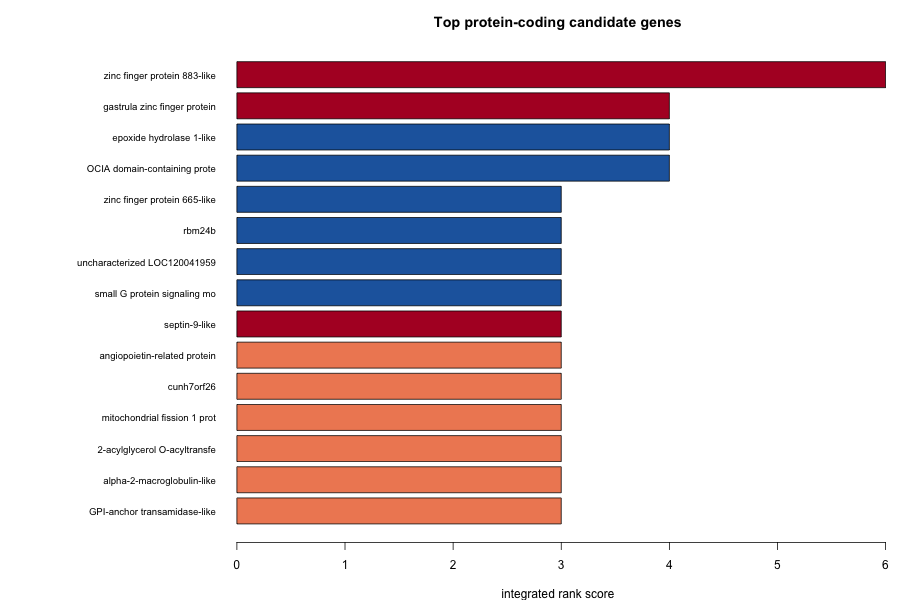
The single-reference analysis promoted four “convergent” genes (a DMR plus a stringent siscowet deletion) and a lipid axis built on exonic deletions. Under the two-genome model:
Native support means at least one evidence line comes from comparing the two ecotype assemblies directly, with no reference involved: reciprocal PAV (read-level absence, tested in both directions), corroborated ecotype-only (the gene lifts into one assembly and is explicitly unmapped in the other), copy-number divergence between the assemblies, or a native DMR replicated on both assemblies. Reference DMRs and deletions or SVs called against the reference do not count. In the table, weak marks a copy-number difference inside a paralog cluster, where Liftoff may not distinguish which copy differs; assembly-level only marks agreement between the two annotations without a read-level reciprocal test.
| Gene | Product | Earlier role | Now | Native support |
|---|---|---|---|---|
| LOC120032414 | Zinc finger protein 883-like | top convergent | reference divergence only; its reference DMR is not a native DMR | no |
| LOC120040411 | Gastrula zinc finger XlCGF57.1-like | convergent | Tier B via copy-number, inside a 5-paralog cluster | weak |
| LOC120043843 | Septin-9-like | convergent | reference divergence only | no |
| LOC120039781 | Uncharacterized | convergent | reference divergence only | no |
| LOC120050008 | Angiopoietin-related protein 5-like (angptl5) |
lipid axis | none: present in both ecotypes, missing from the lean assembly | no |
| LOC120041635 | 2-acylglycerol O-acyltransferase 2-A-like (mogat2) |
lipid axis | reference divergence only | no |
| LOC120029926 | Epoxide hydrolase 1-like | lipid axis | reference divergence only | no |
The stringent siscowet “deletions” that defined these genes came from siscowet reads aligned to the lean-background reference, a one-direction test that cannot separate true loss from sequence too divergent to align. On the ecotype genomes they are largely not confirmed: mogat2-like lifts into both assemblies with no reciprocal absence, and angptl5-like is covered by lean reads at genome depth in all four lean fish; it and its ~280 kb neighbourhood are missing from the lean assembly, not from lean fish. That is the outcome the two-genome design was built to detect.
Hypothesized Links to Ecotype Biology, Revised
- ⚡ Calcium handling and excitability (weakened) — the lean-only calcium-channel enrichment did not survive the read-coverage check: siscowet fish carry those genes too. What remains is a calcium-binding enrichment in the reciprocal PAV set (FDR 0.10), and calsequestrin-1,
cracr2band fast-muscle troponin T among the siscowet-present tier-A genes. Plausibly relevant to muscle function in a deep, cold habitat, but now a handful of genes rather than a pathway signal. - 🔋 Energy metabolism and insulin signalling (new, narrowed) —
gpia, mitochondrial PEPCK, two phosphodiesterases,grb10-like and a ROR-alpha paralog carry read-level presence/absence segments. Onlygpiaandgrb10-like lose coding sequence; the rest are intronic, so any effect would be regulatory. A metabolic-rate or fuel-partitioning hypothesis fits the lean/siscowet contrast better than the earlier lipid-storage genes did, but it rests on a handful of genes. - 🫧 Lipid storage (demoted) — the defining siscowet phenotype, yet the earlier lipid-gene deletions, called against the lean-background reference, are not supported on the ecotype genomes (most likely reference divergence rather than gene loss), and no lipid GO term is enriched on native coordinates. This does not rule out a genetic basis: it may be regulatory rather than structural, or lie in genes Liftoff cannot see. Native methylation found no lipid signal either (a DGAT2-like promoter is one nominal exception); de novo annotation (Phase 4) is the remaining test.
- 🛡️ Immune — PTPRC, an MHC class I-related gene, CEACAM and TRIM39 appear in tier A. These families evolve fast and vary in copy number within populations; treat as expected background until population-level data exist.
- 🩸 Hemoglobin cluster: resolved as an assembly gap — the 18 “lean-only” hemoglobin genes on NC_052347.1 are fully covered by siscowet reads in all four siscowet fish. Siscowet fish carry the cluster; the siscowet assembly does not.
Interactive Genome Browsers
Explore methylation, PAV, gene, and ecotype-synteny tracks across the SaNama_1.0 assembly. Genes carry functional annotation, and lean/siscowet synteny blocks are projected onto the reference. JBrowse also offers a lean ↔︎ siscowet Linear Synteny View on the purged assemblies. Structural variant and reciprocal PAV tracks are planned for Phase 5. Native DMRs are available: placed on SaNama_1.0 in both browsers, and on the lean and siscowet purged assemblies in JBrowse.
🔬 IGV.js — quick exploration
Functionally-annotated genes · lean & siscowet synteny blocks · PAV insertions & deletions · CpG methylation (8 samples) · native & reference DMRs
🧬 JBrowse 2 — advanced analysis
Functionally-annotated genes (GFF3) · synteny blocks · PAV structural variants · CpG methylation · native DMRs on all three assemblies · lean ↔︎ siscowet Linear Synteny View
Open the Linear synteny view and pick the lean_purged and siscowet_purged assemblies with the Lean ↔︎ Siscowet synteny track.
Interpretation Guardrails
Partly retired: the lean-reference caveat. Presence/absence and gene-content comparisons are now made on each ecotype’s own genome and cross-checked in both directions. The reference is still the shared coordinate axis for gene IDs, SVs and methylation, and the reference-divergence line still inherits its bias, which is why it counts once.
Contig-level assemblies and Liftoff sensitivity. Both genomes are thousands of contigs. The raw ecotype-only gene counts (5,058 lean, 9,589 siscowet) track assembly contiguity more than biology. Even genes where both assemblies agree are mostly assembly gaps: 89 % are covered by the other ecotype’s reads. Only the 491 genes that pass both checks count as evidence.
Methylation: compare on a shared genome. Pairing promoters across the two assemblies by gene ID produced >1,000 apparent differences that vanish when both ecotypes’ reads are tested on the same assembly. Tested that way, ~137 short DMRs replicate in both directions, while promoter- and gene-wide methylation does not differ. The evidence model now uses these native DMRs; the reference DMRs (whose thresholds carry ~40 % expected false calls) are kept for reference only. No native DMR has a fixed sequence difference within 1 kb, but differentiated SNVs (2–3×) and ecotype copy-number-like depth differences (~2×) are enriched at them (23.15): genetic and epigenetic divergence are entangled. Where a fish is heterozygous for a differentiated SNV (~20 % of DMRs), reads phased by allele show methylation following the haplotype (allelic difference ≈ 0.8 × the ecotype difference, both frames; 23.16): mostly cis-genetic, with a smaller trans / environmental part in siscowet. Only ~70 % of replicated native DMRs place uniquely on SaNama_1.0, so the reference-coordinate browser track is a subset; the purged-assembly tracks in JBrowse show all of them.
Two lean genomes differ as much as lean and siscowet at the sequence level. A difference between our two assemblies is ecotype-informative only if the published lean sides with our lean (23.17). Reciprocal PAV marks segments, not whole genes: 90 % are intronic (23.18).
Small numbers, no validation. Four fish per ecotype. Tier-A GO terms rest on three to five genes each. All links are associations with no functional test; the liver RNA-seq comes from a separate parasite study and is orthogonal support at best.
Data & Methods
Genomes
- Reference: NCBI GCF_016432855.1 (SaNama_1.0), RefSeq GFF + GO
- Ecotype assemblies: hifiasm primary contigs from PacBio HiFi, purged with purge_dups; lean 2.58 Gb / 12,700 contigs, siscowet 2.84 Gb / 8,159 contigs. Annotated by Liftoff from the reference with reference-identical gene IDs.
Samples
| Ecotype | n | Data |
|---|---|---|
| Lean | 4 | PacBio HiFi with 5mC calling (bc2041, bc2068, bc2069, bc2070) |
| Siscowet | 4 | PacBio HiFi with 5mC calling (bc2071, bc2072, bc2073, bc2096) |
Analysis pipeline
- PacBio HiFi alignment to reference; CpG methylation and DMR calling
- Coverage/CIGAR PAV detection against the reference
- RefSeq functional annotation backbone; feature-to-gene assignment; GO over-representation
- hifiasm assembly per ecotype, purge_dups, Liftoff annotation, MCScanX synteny
- RagTag anchoring to reference chromosomes; MUMmer + SyRI structural-variant calling; PAV cross-validation
- Reciprocal PAV: each ecotype’s reads aligned to the other’s purged assembly (pbmm2, mosdepth, CIGAR)
- Shared / ecotype-only / copy-number gene sets from the two Liftoff annotations
- Five-line evidence model with tiers; tandem-cluster-collapsed GO over-representation
- Lean vs published-lean baseline: lean–siscowet SVs polarized against the reference; exon placement of reciprocal-PAV segments
Next
- Methylation follow-up — population sample of both ecotypes to test the cis haplotypes and the ~80 % of DMRs that cannot be phased with four fish
- Phase 4 — BRAKER3 de novo annotation to recover genes absent from the reference
- Phase 5 — browser tracks for SV / reciprocal PAV / native DMRs; manuscript; NCBI assembly submission
Citation & Resources
- GitHub Repository: RobertsLab/project-lake-trout
- Two-genome plan and progress log:
code/23-next-phase-research-plan.md - Refined evidence model:
analyses/23-integration/refined/README.md - Lean vs published-lean baseline:
analyses/23-lean-baseline/README.md - Single-reference annotation layer (2025):
code/18-diff-annotation-phenotype-plan.md